CryoSpa Serena
- COMMERCIAL ICE BATH
Advanced Cold Immersion, Redefined for Wellness Spaces
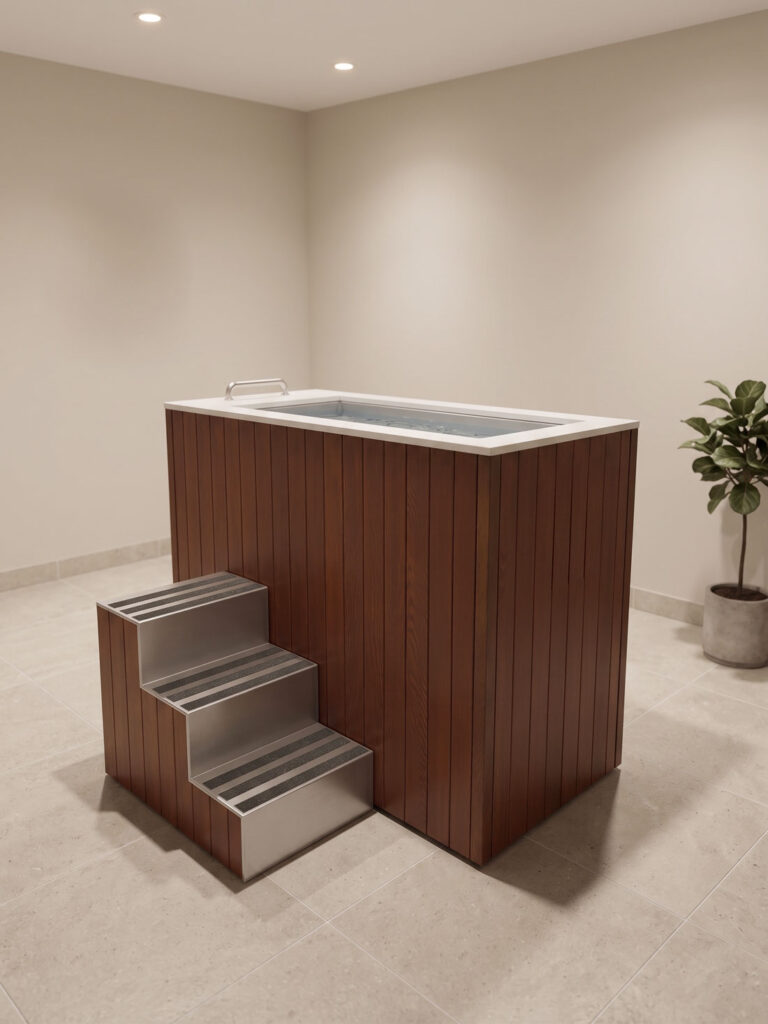
Serena has been engineered to complement high-end wellness environments, combining a durable stainless-steel interior with a refined luxury wood exterior to deliver both performance and visual appeal. Its clean, modern profile ensures seamless integration into spa and gym settings, while maintaining the durability, hygiene, and reliability required for commercial use.
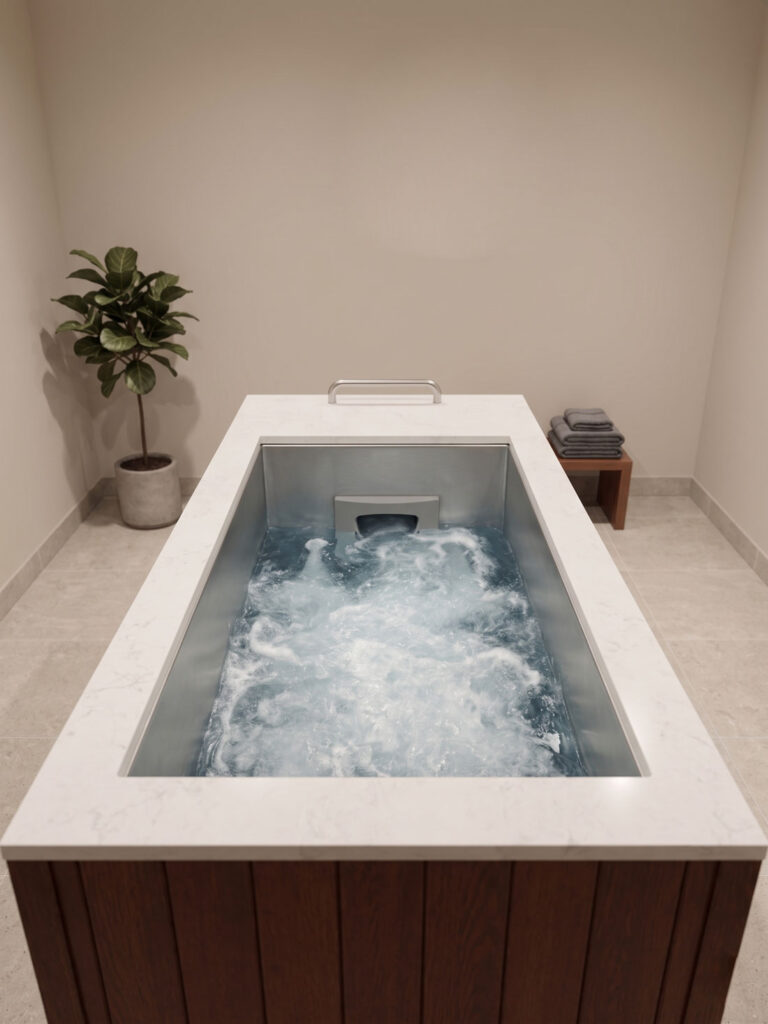
The CryoSpa Serena utilises CET’s patented jet system to actively circulate water, maintaining consistent temperature distribution and ensuring uniform cold exposure across the body. Combined with its increased immersion depth, the system enhances hydrostatic pressure, supporting circulation, and more efficient recovery outcomes within high-usage wellness and gym environments.
The automated water management package is available across CET’s commercial ice bath range, so every facility can add fully automated dosing, backwashing and remote monitoring regardless of which model fits their space.
Features Include
- Patented jet technology for active water circulation.
- Increased immersion depth for enhanced hydrostatic pressure.
- Stainless steel interior with luxury wood exterior finish.
- Engineered for consistent temperature control and commercial use.
- Full automation available optional.
Benefits Include
- Delivers deeper, more effective cold exposure for improved recovery outcomes.
- Supports circulation and muscle recovery through hydrostatic pressure.
- Enhances facility aesthetics while maintaining durability and hygiene standards.
- Enables reliable, high-frequency usage in busy gym and wellness environments.
Power
- 230v / 1 / 50hz
Dimensions Spa
- L x W x H: c. 1.65m x 0.80m x 1.20m / c. 61″ x 31″ x 30″
Weight
- Empty: c. 320 kg / 706 lbs
- Full: c. 870 kg / 1918 lbs
Chiller
- Low noise low temperature chiller.
E.&O.E.
Request Information
Complete our form
Frequently Asked Questions
Why do footballers take ice baths?
It is quite commonly stated that ice baths reduce lactic acid but this is not the case. Lactic acid, or lactate, occurs when the body gets into an oxygen debt situation i.e. is functioning anaerobically. When the level of activity ceases, or reduces sufficiently, in simple terms the body can acquire surplus oxygen, which is used to convert the lactic acid back to its normal pyruvate / pyruvic acid state.
According to Gregory Dupont, who presented at the FIFA sponsored Sports Injury Summit held at Wembley in 2013 the main precursor of injury is fatigue. Further research investigated the common strategies for aiding recovery, minimising fatigue and, thereby, lowering the risk of injury.
The conclusion was good diet, good sleep, hydration [all lifestyle factors] plus cold water immersion were the main scientifically proven methods of aiding recovery and minimising fatigue.
The other side of the coin is performance and here we find that fatigue inhibits performance. So if we can manage fatigue by improving fitness and aiding recovery the outcome is improved performance and lowered risk of injury.
What is the optimum temperature for ice bath recovery?
Should I use an ice bath after every training session?
The debate on the use of ice baths, or cold-water immersion, rages on with many pundits claiming it is good and others claiming it is not.
The answer depends on the stage of training the athlete is at and the main objective of that training block.
If you are in the pre-competition phase of training and the main objective is to build power then there is research indicating that ice baths (and other micro-strategies for minimising training responses, such as anti-oxidant supplementation) during this phase may limit the adaptation effect i.e. your muscles will adapt to the increased workload faster if the body is allowed to contend with the inflammation and micro-tears naturally without the intervention of cold water immersion.
However, if you are tapering the workload toward an upcoming competitive event or if you are in the competitive part of the season then the main focus shifts to recovery and minimising fatigue rather than power building and in these circumstances research indicates the use of ice baths will be beneficial.
The key word here is fatigue. Fatigue is the main precursor of injury and is also a major performance inhibitor. Consequently, the fitness coach’s objective is to maximise fitness and minimise fatigue in order to maximise performance and lower the risk of injury.
And the main strategies for combating fatigue: Good Sleep, Good Diet, Hydration and Cold Water Immersion [per Gregory Dupont, FIFA Sports Injury Summit, Wembley Stadium, April 2013].
The argument is further complicated in team sports where skill, tactics and pre-planned moves need to be coached on the training pitch. In these sports the coach will want the players to be mentally alert and physically prepared to benefit fully from the coaching session, not hobbling around only partially recovered from the previous day’s training. In this instance, there may be a conflict of interest where the fitness coach is trying to maximise adaptation while the team coach wants the players recovered sufficiently to benefit fully from the training session, therefore, CWI may be strategically used to fit the on-going training session plans rather than eliminated to cater for both objectives.
So are ice baths good or bad?
The answer depends on the part of the season and the main objective of the current training regime. In the competitive phase of the season the use of ice baths will help minimise fatigue and aid recovery, thereby improving performance and lowering the risk of injury. In the pre-season, or power-building phase, of training the use of ice baths may adversely affect the adaptive response.
So, as with most tools in the athlete preparation toolbox, it is how the coach uses CWI to best effect, rather than whether it is appropriate to use it or not!
Browse common questions that may give you the answer. Have a question not here? Contact Us.


